Children, AI and Educational Games: What Recent Research Tells Us
Four recent sources, their findings and limitations: practical ideas for independence, knowledge, creativity, coding, and progressive learning levels that assess understanding rather than winning.
What does this review add?
This is a selective review of credible sources available by 26 October 2026, not an exhaustive search or a claim that every source appeared this week. We selected two research reviews, an international report, and child-rights guidance rather than repeating general screen-time or AI-use advice.
The contribution is to connect evidence with specific design decisions: when to offer a hint, how to distinguish a better product from a child’s learning, and when to increase difficulty. Bracketed numbers refer to the original sources below. The activities and progression criteria are editorial proposals to pilot, not outcomes tested in Katkuti.
[1] OECD 2026: completing a task is not the same as learning
Finding: the Digital Education Outlook 2026, published on 19 January, explains that general-purpose tools can improve task performance without equivalent learning gains when support is removed. Pedagogically intentional uses, including dialogue and hints, can support learning, critical thinking, and collaboration.
Limits: this synthesizes varied research and educational settings; it is not a single trial with young children or Arabic-speaking learners. Improvement percentages from a particular study cannot be generalized across ages, and not every chatbot is an effective tutor.
Proposed activity: ask the child to answer a question such as “Why does this object float?” first. An adult offers a suitable hint, then asks for the child’s revised explanation. In a later session, try a similar question without the tool; this is more informative than judging the quality of an AI-produced answer.
[2] September 2026 review: creativity is promising, not proven
Finding: a systematic scoping review in Frontiers in Psychology mapped 24 sources: 22 primary empirical studies and two syntheses used for context only. Studies reported possible benefits for idea generation, narrative creativity, and creative self-efficacy. Its evidence search was updated in May 2026.
Limits: the review conducted no formal critical quality appraisal and included non-peer-reviewed primary sources, heterogeneous designs, and geographically concentrated evidence. It does not establish general efficacy or lasting benefits, and cannot justify claims that AI changes a child’s personality.
Proposed activity: the child invents a story opening and two endings independently. An adult asks the tool for a third suggestion, then they discuss which ending fits the character and what to reject or change. The child’s voice and decisions remain central instead of copying a finished story.
[3] Scratch review, 2026: scaffolding over random trial and error
Finding: Sun, Wang and Wei reviewed 46 empirical K–12 studies. First published on 11 March 2026, the review searched studies through October 2024. It highlights task difficulty, structured activities, collaboration, and instructional support, while identifying abstract concepts and reliance on trial and error as challenges.
Limits: evidence concentrates on primary and middle schools, with little representation of kindergarten, high school, and non-STEM subjects. This is a thematic instructional review, not a pooled improvement estimate, a test of Katkuti games, or evidence of automatic transfer to reading.
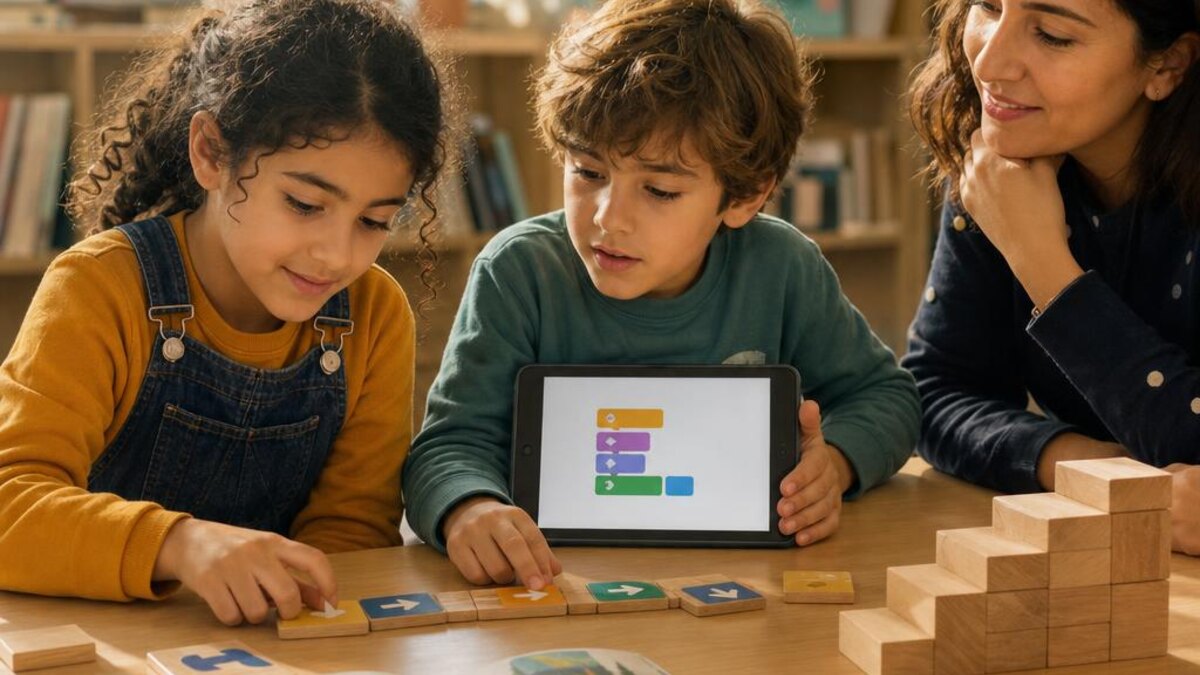
Proposed activity: in a coding maze, ask children to predict the character’s position before running the program. Start with three sequential steps, then a repeated pattern, then one condition. After a failed attempt, ask “Which step differed from your prediction?” rather than encouraging unexplained random changes.
[4] UNICEF 3.0: privacy and agency belong in the design
Guidance: UNICEF updated its Guidance on AI and Children in December 2025. Its ten requirements include safety, privacy, fairness, transparency, development, and well-being, with new attention to AI companions and their risks.
Limits: this is evidence-informed rights and policy guidance developed through consultation, not an experiment measuring attainment or personality. Following it does not establish that an activity improves reading or treats a developmental difficulty.
Proposed activity: an adult mediates tool use in accordance with its age requirements, explaining that it can be wrong and is not a human friend. Use fictional examples instead of children’s names, images, voices, or personal data, and provide an equivalent paper activity and access to human help.
From receiving an answer to building reliable knowledge
A proposed activity informed by [1] and [4] is “information detective.” Choose a narrow question, such as “Can all insects fly?” The child records a prediction, then checks the tool’s answer with an adult against an independent age-appropriate source, such as a science book or museum website. A link alone is not enough: open it and check whether it supports the claim.
Classify statements as “we found evidence,” “needs checking,” or “opinion.” Finish with an explanation in the child’s own words and a counterexample such as a worker ant. When sources disagree or verification is not possible, “we do not know yet” is acceptable; misplaced confidence should not be rewarded.
Personal development: observe actions, do not label children
Here, personal development means opportunities for independence, persistence, collaboration, and empathy, not measuring or diagnosing fixed traits. The selected sources do not establish that a game or AI tool improves personality in the long term.
In a paired activity, children alternate “planner” and “reviewer” roles. Each explains a suggestion and restates the partner’s view before disagreeing. In a story about conflict, the adult asks how the other person felt and what a fair solution might be. These are proposed educational practices, not causal effects established by this review.
Observe specific actions: did the child request a hint rather than the solution, revise and explain a plan, or listen to a partner? Do not turn observations into a personality score or public comparison, or interpret technical failure as a deficit in the child.
Five progressive levels to pilot
This is a proposed design sequence informed by [1] and [3], not a validated developmental standard. Choose the starting point using readiness, language, and accessibility rather than age alone. Change one difficulty variable at a time, such as the number of steps or amount of support.
- 1 — Notice and predict: choose between two outcomes and explain, with a worked example, pictures, or shared reading.
- 2 — Sequence and run: order three steps or story events, then compare the result with the prediction, with hints on request.
- 3 — Explain and debug: repair one error and explain its cause; introduce a repeating pattern after sequencing is secure.
- 4 — Verify and compare: assess a claim or two solutions using an independent source or practical test, with fewer hints.
- 5 — Create and transfer: design a new story or challenge and apply the skill in a different context without a ready-made answer.
A language extension: reading, spelling, speech, and syllables
The sequence can be piloted with a short teacher-reviewed text: hear a word in a meaningful context, read it or arrange previously taught letters, explain the choice, then use it in a new sentence. This is a proposed design transfer, not a direct literacy finding established by the coding or creativity studies cited.
For syllable activities, a knowledgeable teacher prepares language- and dialect-appropriate examples; a syllable is not necessarily a letter or a unit of meaning. An adult checks pronunciation, vowel markings, and segmentation before use. Do not rely on automated right-or-wrong judgments of a child’s speech or collect voice recordings for this activity. Persistent speech concerns require a qualified professional, not a game.
How do we judge value, and when should this review change?
Before the activity, try a brief task; afterwards, a similar example; and in a later session, a new example without the tool. Adults can keep simple observations about explanations and support needed without creating child profiles. Stars and time in a game do not establish mastery or a causal benefit.
One pilot progression rule is two independent attempts on different examples with an appropriate explanation. This is a provisional practical criterion to adapt and evaluate, not a fixed scientific threshold. When a child struggles, increase support or change presentation rather than automatically lowering the goal or awarding success without understanding.
A future review should not repeat a source merely because the date changed. Look for a larger sample, a stronger comparison, long-term follow-up, new Arabic-language evidence, or a material safety-guidance update. When no important update is found, say so rather than presenting a recycled conclusion as news.
Original sources
- [1] OECD — Digital Education Outlook 2026: Exploring Effective Uses of Generative AI in Education (19 January 2026)
- [2] Niu et al. — The role of generative AI in facilitating children’s creative thinking and cognitive development: a systematic scoping review (September 2026)
- [3] Sun, Wang & Wei — Teaching Computational Thinking Skills Through Scratch in K–12 Education: A Systematic Review (11 March 2026)
- [4] UNICEF — Guidance on AI and Children, Version 3.0 (December 2025)

