STEM at Home: A Practical Start with Science, Technology, Engineering, and Math
What does STEM really mean? Safe home ideas that invite children to ask, measure, design, and revise—with no promises or certificates.

What does STEM mean?
STEM stands for Science, Technology, Engineering, and Mathematics. It is an approach that brings these fields together around a question, problem, or design; it is not a certificate and not one fixed program. A child might notice what floats, use a simple tool to record observations, design a paper bridge, and measure its length or how many books it holds. The fields meet in one experience.
Parents do not need to be engineers or own a laboratory. In a useful home STEM routine, a child asks a question, predicts, tries something safely, records what happened, and revises the idea. The result may differ from the prediction, and that is part of scientific thinking. Present the activity as age-appropriate practice, not a test or a claim that it awards a credential.
- Science: What do we observe, and what might explain it?
- Technology: Which tool or method helps us complete the task?
- Engineering: How can we design and improve a solution?
- Math: How can we measure, count, compare, or represent the data?
Choose an activity that fits the age and materials
For ages 3–5, sort safe lids by color and size, or predict which objects will float in a bowl under adult supervision. Let the child describe what they see and count the pieces. For ages 6–8, build a bridge from paper and blocks, test how many books it can hold, and use a ruler to notice what changed after each revision.
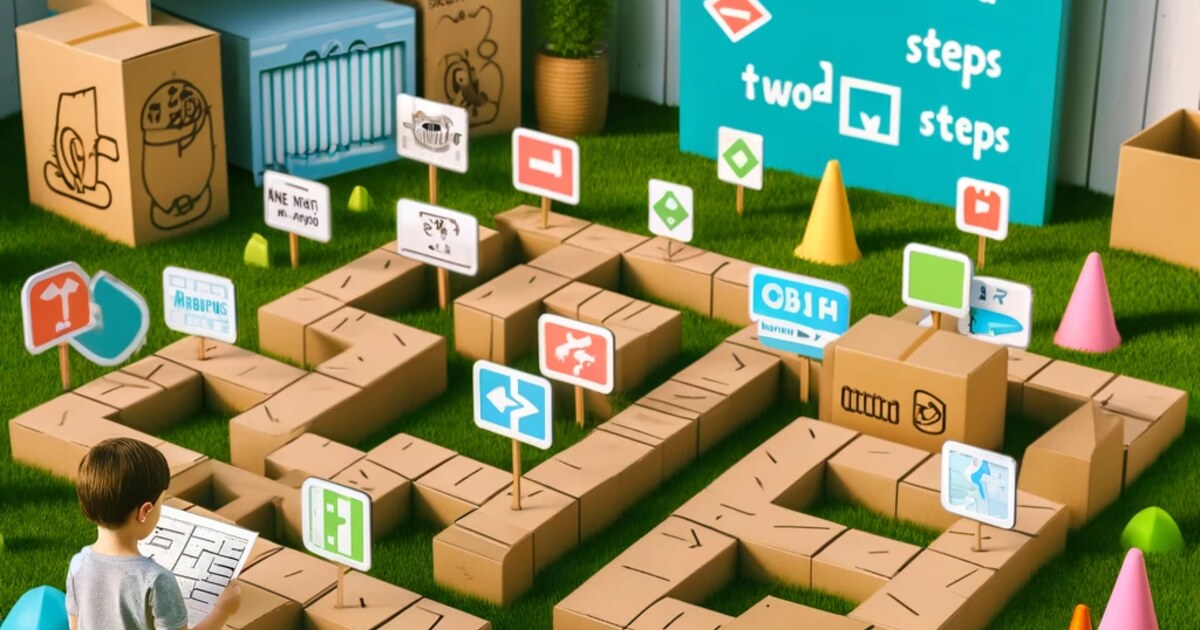
For ages 9–12, invite the child to design a container that keeps an ice cube cold longer using available household materials, or draw an organized path through a maze and compare two designs. Use scissors, water, and small pieces with adult supervision and clear directions. Do not turn it into a speed contest; allow time to think and revise, and change the question when materials or space require it.
Follow a question, test, and revise cycle
Before starting, put the question in the child’s words: “Which shape makes the bridge stronger?” or “How many steps will reach the goal?” Ask for one prediction and a simple reason. After testing, draw results, count pieces, or measure distance. These small records make evidence tangible even when the answer is approximate.
Then ask, “What could we change next time?” Change one variable where possible, such as the paper type or bridge width, so the child can compare what happened. If the design fails, do not fix it immediately. Say, “Let’s review the plan,” and invite a second sketch. Repeating the cycle matters more than reaching a perfect solution on the first try.
- Before: What do we predict, and why?
- During: What are we observing or measuring?
- After: What small change will we try next?
Connect STEM to digital play without reducing the experience
A maze or sequence game on Katkuti can open a conversation about ordering instructions, planning, and testing. Ask the child to predict the path before tapping, then describe which command needed changing. A number game can lead to counting and comparison when it is followed by a question, drawing, or measurement in the real world.
The device is one tool, not the whole laboratory. After a round, make a paper-tape maze on the floor, write a sequence of commands to move a toy, or compare the lengths of three objects in the room. If the child needs help, offer a hint rather than a ready-made solution. Screen time then becomes one part of a STEM cycle alongside hands-on play and exploration.
Safety and curiosity matter more than the result
Choose non-toxic materials that are large enough for younger children, and supervise water, heat, sharp tools, and small parts. Stop when an activity becomes unsafe or tiring, and never ask a child to taste materials or touch electricity. With older children, discuss why a safety rule exists, so they understand that good design protects its users.
FAQ: Does a child need the right answer for an activity to be STEM? No. A child can learn from an unconfirmed prediction by describing what happened and proposing another test. How often should we repeat it? Try 15–30 minutes once or twice a week, depending on age and interest. There is no guaranteed outcome or certificate; build a calm habit of asking, testing, and revising.